Each decision you make while playing blackjack has a positive or negative
impact on your potential profit or loss. Every situation you have while playing
has a single best way to play.
- Blackjack Hit Card
- How To Play Blackjack Strategy
- Blackjack Hit Chart
- Blackjack Strategy After First Hitman
After the first round of dealing, each player has the option to hit (receive more cards) or stay (no more cards). If hitting results in the player busting (total going over 21), then his or her bet is lost. After all the players are done hitting/staying, the dealer flips over his hidden card. The correct basic playing strategy for hard 16 is to stand when the dealer shows a small card (2 through 6) and hit when the dealer shows a high card (7, 8, 9, 10, or Ace). Following this playing strategy will not guarantee that you will win every time but that you are more likely to lose less in the long run. Blackjack strategy is confusing when you first start out with the game. After all, how are you supposed to know when to hit, stand, split, or double down based on instincts? The truth is that you won’t automatically know how to handle all these situations as a beginner. But the good news is that it’s not hard to learn blackjack strategy. I have a question about the two blackjack strategies your 8 deck blackjack strategy. First off, the underlying assumption before this question is that hitting on a soft 17 is an advantage to the dealer. Why does the strategy have the player double down more often in situations where the dealer might hit a soft 17,i.e, dealer shows an A or 6.
If you make the correct play it either makes you the most money in the long
run or loses the least amount of money in the long run. This is called basic
strategy.
Some hands lose money in the long run and some win in the long run, so your
job is to make the best possible play to maximize the wins and minimize the
losses.
When you read about the expected house edge in blackjack games based on the
rules the percentages are based on perfect basic strategy. If you don’t use the
proper strategy you give the house a higher edge against you. This can add an
extra one or two percent to the house edge, depending on how far from the proper
strategy you stray.
You can usually find blackjack games with rules that offer a house edge of
less than 1%, and can often find games with a house edge under a half percent.
If you don’t use basic strategy you can be playing with a house edge of 1.5% to
3% instead of a half percent.
This quickly adds up.
Here’s an example:If your average bet is $100 and you play 100 hands per hour and you give the
casino and extra 1% you lose an extra $100 per hour. By giving them an extra 2%
it’s $200 per hour.
If you want to play blackjack the first thing you need to do is decide to
always make the best possible play.
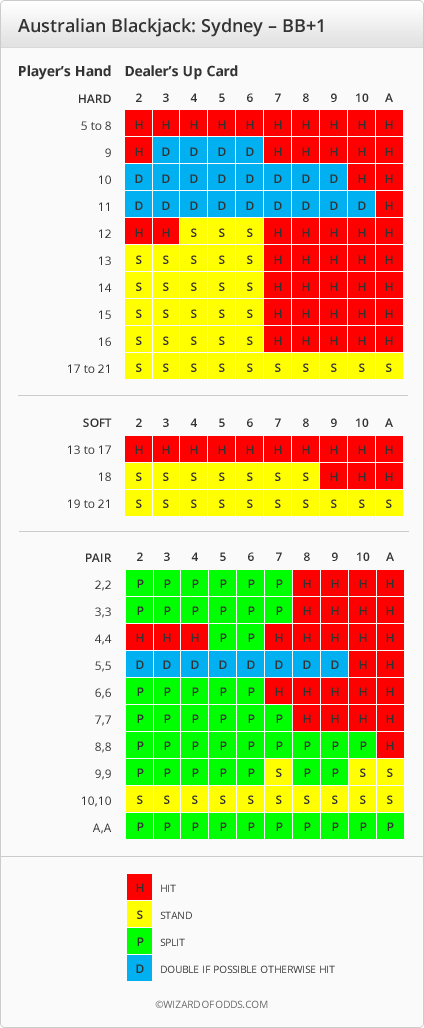
You probably realize that there are hundreds of hands when you combine all of
the possible hands you can have with the different up cards the dealer can have.
The good news is that by using a simple chart you can quickly find the best
play. And you can use a strategy chart or card at the table while playing in a
live casino or when playing online.
If you play in a live casino some of the other players may try to pressure
you if you take too long to make a decision. But it’s none of their business and
you can play any way you want as long as you don’t hold up the game too long.
Blackjack Hit Card
If you’re worried about holding up the game sit in the middle of the table or
to the dealer’s right hand side so you have longer before you have to act. This
gives you more time to consult your strategy chart before being force to make a
decision.
You don’t even need to memorize the best plays.

But with a little effort and time you can quickly memorize the most common
plays and in time memorize all of the best plays.
The next section has a chart and the following section has the hand by hand
explanations. Then you’ll find a section explaining a few ways to start
memorizing all of the plays.
Basic Strategy Chart
This is the most universal basic strategy chart and can be used in all
blackjack games with any rule combinations. A few small adjustments can be made
against certain rules combinations, but it becomes complicated to memorize
multiple charts. We’ve included a short section later explaining these
adjustments for the dedicated player.
The dealer’s up card is listed across the top. Your cards are listed down the
first column to the left. Simply go down the left column until you find your
cards and then go across to the column with the dealer’s card to find the best
play.
The key for each play is as follows:
- Hit – Hit
- Stand – Stand
- DblH – Double
- DblS – Double if permitted, otherwise stand
- Split – Split
- SplitD – Split if double after split is permitted, otherwise hit
- SUR – Surrender if permitted, otherwise hit
| Your Hand | Two | Three | Four | Five | Six | Seven | Eight | Nine | 10 | Ace |
|---|---|---|---|---|---|---|---|---|---|---|
| 2 – 2 | SplitD | SplitD | Split | Split | Split | Split | Hit | Hit | Hit | Hit |
| 3 – 3 | SplitD | SplitD | Split | Split | Split | Split | Hit | Hit | Hit | Hit |
| 4 – 4 | Hit | Hit | Hit | SplitD | SplitD | Hit | Hit | Hit | Hit | Hit |
| 5 – 5 | DblH | DblH | DblH | DblH | DblH | DblH | DblH | DblH | Hit | Hit |
| 6 – 6 | SplitD | Split | Split | Split | Split | Hit | Hit | Hit | Hit | Hit |
| 7 – 7 | Split | Split | Split | Split | Split | Split | Hit | Hit | Hit | Hit |
| 8 – 8 | Split | Split | Split | Split | Split | Split | Split | Split | Split | Split |
| 9 – 9 | Split | Split | Split | Split | Split | Stand | Split | Split | Stand | Stand |
| 10 – 10 | Stand | Stand | Stand | Stand | Stand | Stand | Stand | Stand | Stand | Stand |
| Ace – Ace | Split | Split | Split | Split | Split | Split | Split | Split | Split | Split |
| Two | Three | Four | Five | Six | Seven | Eight | Nine | 10 | Ace | |
| Soft 13 | Hit | Hit | Hit | DblH | DblH | Hit | Hit | Hit | Hit | Hit |
| Soft 14 | Hit | Hit | Hit | DblH | DblH | Hit | Hit | Hit | Hit | Hit |
| Soft 15 | Hit | Hit | DblH | DblH | DblH | Hit | Hit | Hit | Hit | Hit |
| Soft 16 | Hit | Hit | DblH | DblH | DblH | Hit | Hit | Hit | Hit | Hit |
| Soft 17 | Hit | DblH | DblH | DblH | DblH | Hit | Hit | Hit | Hit | Hit |
| Soft 18 | Stand | DblS | DblS | DblS | DblS | Stand | Stand | Hit | Hit | Hit |
| Soft 19 | Stand | Stand | Stand | Stand | Stand | Stand | Stand | Stand | Stand | Stand |
| Soft 20 | Stand | Stand | Stand | Stand | Stand | Stand | Stand | Stand | Stand | Stand |
| Soft 21 | Stand | Stand | Stand | Stand | Stand | Stand | Stand | Stand | Stand | Stand |
| Two | Three | Four | Five | Six | Seven | Eight | Nine | 10 | Ace | |
| Hard 4 | Hit | Hit | Hit | Hit | Hit | Hit | Hit | Hit | Hit | Hit |
| Hard 5 | Hit | Hit | Hit | Hit | Hit | Hit | Hit | Hit | Hit | Hit |
| Hard 6 | Hit | Hit | Hit | Hit | Hit | Hit | Hit | Hit | Hit | Hit |
| Hard 7 | Hit | Hit | Hit | Hit | Hit | Hit | Hit | Hit | Hit | Hit |
| Hard 8 | Hit | Hit | Hit | Hit | Hit | Hit | Hit | Hit | Hit | Hit |
| Hard 9 | Hit | DblH | DblH | DblH | DblH | Hit | Hit | Hit | Hit | Hit |
| Hard 10 | DblH | DblH | DblH | DblH | DblH | DblH | DblH | DblH | Hit | Hit |
| Hard 11 | DblH | DblH | DblH | DblH | DblH | DblH | DblH | DblH | DblH | Hit |
| Hard 12 | Hit | Hit | Stand | Stand | Stand | Hit | Hit | Hit | Hit | Hit |
| Hard 13 | Stand | Stand | Stand | Stand | Stand | Hit | Hit | Hit | Hit | Hit |
| Hard 14 | Stand | Stand | Stand | Stand | Stand | Hit | Hit | Hit | Hit | Hit |
| Hard 15 | Stand | Stand | Stand | Stand | Stand | Hit | Hit | Hit | SUR | Hit |
| Hard 16 | Stand | Stand | Stand | Stand | Stand | Hit | Hit | SUR | SUR | SUR |
| Hard 17 | Stand | Stand | Stand | Stand | Stand | Stand | Stand | Stand | Stand | Stand |
| Hard 18 | Stand | Stand | Stand | Stand | Stand | Stand | Stand | Stand | Stand | Stand |
| Hard 19 | Stand | Stand | Stand | Stand | Stand | Stand | Stand | Stand | Stand | Stand |
| Hard 20 | Stand | Stand | Stand | Stand | Stand | Stand | Stand | Stand | Stand | Stand |
| Hard 21 | Stand | Stand | Stand | Stand | Stand | Stand | Stand | Stand | Stand | Stand |
| Two | Three | Four | Five | Six | Seven | Eight | Nine | 10 | Ace |
Expand Shrink
Text Version and Vision Impaired
Many players use the chart listed above but a few players prefer to read the
correct plays. Having the correct plays written out also is valuable to people
who have vision problems and use software to hear what’s on the page.
We’ve listed the proper plays for each situation below in four sections.
Simply find the section that describes your hand and follow the instructions.
Hands with an Ace or Soft Hands
Any starting hand you hold with an ace is called a soft hand. A soft hand is
when you have an ace that can be used as a one or 11. In the following
combinations, if you have more than two cards, simply add the cards that aren’t
an ace.
This can happen when you start with an ace and a different side card and hit.
Starting with an ace two and receiving a four after hitting leaves you with ace
two four. Looking at the chart you look at the line for a soft 17. Using the
list below you look at the one for ace six because the two and four add up to
six.
- Ace ace – Always split a pair of aces. Split aces as many times as allowed.
- Ace two or soft 13 – You always hit with a soft 13 and double if allowed
against a dealer five or six. - Ace three or soft 14 – Always hit and double against a five or six if
allowed. - Ace four or soft 15 – You always hit with a soft 15 and double if allowed
against a dealer four, five, or six. - Ace five or soft 16 – Always hit and double against a four, five, and six if
allowed. - Ace six or soft 17 – Double against a three, four, five, and six if allowed
and otherwise hit. - Ace seven or soft 18 – Stand against a dealer two, seven, and eight, hit
against a nine, 10, or ace, and double if allowed against three, four, five, or
six. - Ace eight or soft 19 – Stand at all times.
- Ace nine or soft 20 – Always stand.
- Ace 10 – Blackjack! Always stand.
Pairs
Whenever you have a pair for your first two cards you need to decide if you
should split.
- Two two – Split against a dealer four, five, six, and seven, hit against a
dealer eight, nine, 10, and ace, and against a dealer two or three split if you
can double after split and hit if double after split isn’t allowed. - Three three – Play your hand exactly the same as two two. If double after
split is allowed split against a dealer two or three, otherwise hit against
these two cards. Hit against a dealer eight, nine, 10, and ace, and split
against a dealer four, five, sis, and seven. - Four four – When double after split is allowed split against a dealer five
and six, otherwise hit. Hit against all other dealer cards. - Five five – Never split fives. Hit against a dealer 10 or ace and double
against all other dealer cards if allowed. - Six six – Hit against a dealer seven, eight, nine, 10, and ace. Split against
a dealer three, four, five, and six. Split against a dealer two if double after
split is allowed, otherwise hit. - Seven seven – Split against a dealer two, three, four, five, six, and seven.
Hit against a dealer eight, nine, 10, and ace. - Eight eight – Always split eights.
- Nine nine – Split against a dealer two, three, four, five, six, eight, and
nine. Stand against a dealer seven, 10, and ace. - Ten ten – Always stand with a total of 20.
- Ace ace – Aces should always be split. If you receive another ace on one of
your split aces you should split again. Do this as many times as possible.
Hard Totals
A hard total is any hand that doesn’t have an ace where you can use it as a
one or 11. In any two card starting hand you can use an ace as either one or 11,
but after you hit one or more times you can reach a total where the ace can’t be
used as an 11 without busting. When this happens you hold a hard hand.
- Hard four – The only hard four is a pair of twos. This is covered in the two
two line under pairs. If splitting isn’t allowed then always hit with a hard
four. - Hard five – Always hit with hard five.
- Hard six – Hit against all dealer cards with a hard six.
- Hard seven – Always hit with a hard seven.
- Hard eight – Hit against all dealer totals with hard eight.
- Hard nine – If double is allowed, double against a dealer three, four, five,
or six, otherwise hit. Hit against all other dealer cards. - Hard 10 – When double is allowed, double against a dealer two, three, four,
five, six, seven, eight, and nine, otherwise hit. Hit against a dealer 10 and
ace. - Hard 11 – Double against any dealer car except an ace if doubling is
permitted, otherwise hit. Hit against a dealer ace. - Hard 12 – Stand against a dealer four, five, and six. Hit against all other
dealer cards. - Hard 13 – Stand against a dealer two, three, four, five, and six. Hit against
a dealer seven, eight, nine, 10, and ace. - Hard 14 – Stand against a dealer two, three, four, five, or six and hit
against seven or higher. - Hard 15 – Against a dealer two, three, four, five, and six you should stand.
Against a dealer seven, eight, nine, 10, and ace you should hit. - Hard 16 – Stand against a dealer total of two, three, four, five, and six.
Hit against all other dealer totals. - Hard 17 – Stand against all dealer hands.
- Hard 18 – Always stand with a hard 18.
- Hard 19 – Stand against all dealer hands.
- Hard 20 – Always stand with a hard 20.
- Hard 21 – Stand against all dealer totals.
Surrender
If surrender is allowed you should surrender with a hard 15 against a dealer
10 and with a hard 16 against a dealer nine, 10, or ace. If surrender isn’t
allowed then hit in these four situations.
Adjustments for Different Rules
The chart and instructions above are designed for a game where the dealer
stands on a soft 17. If you play in a game where the dealer hits on a soft 17
you can make the following adjustments.
As we mentioned above, it can be complicated to keep two different charts
straight in your mind so learning the first chart is best. However, there are
only six hands that change so it’s possible to learn and use the differences.
Split hands
Instead of splitting eight eight against a dealer ace,
surrender if allowed, otherwise split.
Soft hands
With a soft 18 against a dealer two and with a soft 19 against a
dealer six double if allowed, otherwise stand.
Hard hands
With a hard 11 against a dealer ace double if allowed, hit
otherwise. With a hard 15 against a dealer ace surrender if permitted, otherwise
hit. With a hard 17 against a dealer ace, surrender if permitted and otherwise
stand.
Insurance or Even Money
Notice that there’s not a single hand that recommends taking insurance or
even money. This is because taking insurance is always a losing proposition.
When the dealer has an ace showing you have the option of making another bet
equal to the size of your first bet that pays two to one if the dealer has a 10
hole card. If you take insurance and the dealer has a 21 you lose your first bet
but get double on your second so you break even.
How To Play Blackjack Strategy
But when the dealer doesn’t have 21 you lose the insurance bet and your first
bet plays out as normal.
On the surface this may seem like a good bet, but a simple look at the math
behind the bet shows why you should never take insurance.
When the dealer has an ace showing she has a blackjack any time a 10, jack,
queen, or king is her down card. This means four of the 13 possible cards pay
off on the insurance bet.
But this also means that the other nine cards, two through nine and ace, make
you lose the insurance bet. This is a ratio of nine to four, with nine losing
cards and four winning cards. But the bet only pays two to one.
The odds of nine to four is worse than two to one, so it’s a losing bet.
Forget your normal hand because it doesn’t have anything to do with the
insurance offer. Insurance is just a bet on what the dealer has as a down card.
And since it’s offered at bad odds you can now see that it should be avoided.

This is just another way the casinos try to be sneaky and build a bigger long
term edge against you.
How to Memorize Basic Strategy
The easiest way to start memorizing basic strategy is to use the chart
provided above to make every playing decision. As you play you’ll start
recognizing the correct play for most hands before checking your chart.
Sign up for a free account at one of our recommended online casinos and start
playing the free blackjack games. You can play over 100 hands per hour in most
cases so you can get a great deal of practice in a short amount of time.
Eventually you’ll only need to check your chart on the most difficult plays
and if you play long enough all of the plays will come from memory.
The other way is more difficult for most players, but if you have a strong
mind for memory you can simply start memorizing the chart.
A quick tip is to group similar hands together.
Here’s an example:All of the hard hands totaling four, five, six, seven, and eight are played
the same way. On all of these hands you always hit. If you’re playing a game
where doubling isn’t allowed, you can add all of the hard totals of nine, 10 and
11 to this. As a side note, you should avoid games where doubling isn’t allowed
as they have a higher house edge.
Other easy to learn hands include:
- Always split aces and eights.
- Soft 13 and 14 are played the same.
- Soft 15 and 16 are played the same.
- Soft 17 only has one dealer card played differently than soft 15 and 16.
- Hard 13, 14, 15, and 16 are played the same unless surrender is allowed.
- Hard 10 and 11 are the same except for one dealer card.
- Two two and three three are played the same.
- All of the hard totals 17 and above are played the same.
- All of the soft totals of 19 and above are played the same.
The majority of hands are hard hands and the complete hard hand strategy is
fairly simple. Memorize it first and you’ll find that you won’t need to refer to
the chart often.
The next chart to memorize after you’ve mastered the hard hands is the soft
hands. Most of them are straightforward as well, with the main changes of
knowing when to double down.
Once you have the hard and soft hands memorized the splits will come easy to
finish out your mental chart. You only need to learn the split rules for twos,
threes, fours, sixes, sevens, and nines.
The main thing is to not be afraid that you can’t learn the chart and to get
started right away. Almost anyone can improve their results and reduce the house
edge with a small amount of effort and time.
Card Counting
If you learn how to count cards you can play with a small edge against the
house while playing blackjack. This page is about basic strategy so we aren’t
going to dig into the realm of card counting, but it does have quite a bit to do
with basic strategy.
Card counters learn perfect basic strategy before they start trying to learn
about counting. If you can’t put in the work to learn perfect strategy you have
no hope of being a successful card counter.
Blackjack Hit Chart
Once you master basic blackjack strategy then you should investigate card
counting to see if it’s something you might want to learn. Counting cards online
won’t get you an edge because the software shuffles the cards after each deal,
but if you play live it might be able to help you win or at least play a break
even game.
Conclusion
Learning and using blackjack basic strategy gives you the best chance to win.
It reduces the house edge as much as possible and helps you have more winning
playing sessions.
Most players don’t take the time to learn basic strategy, but if you use the
information above you can quickly start using the best play for every situation.
Use the tips in the how to memorize basic strategy section and you’ll be a
master in no time.
And don’t forget to use the chart provided as you’re learning. Once you get
used to it you can find the proper play in a second or two.
Sure, Blackjack is probably the world’s most loved card casino game. But are you familiar with the game’s protocols and procedures? The following information will help you avoid lots of mistakes when playing Blackjack.
What is Basic Blackjack Strategy?
In order to play Blackjack you should master the basic strategy. It means you should calculate the best move in a certain circumstance depending on your cards and the dealer’s card. What is the goal of the basic strategy? Of course, to win the highest number of times, as well as get as high winnings, as possible. And last, but not least to reduce possible losses.
Actually, the more you play, the less you refer to the Blackjack Strategy guide. Some casinos allow their players to use the printed reference paper at the table, but surely not on your mobile device.
The basic strategy allows you to understand when to hit and when to stand. If you want to learn the basic strategy well, do not try to learn each possible hand, but rather concentrate on the borderline hands. Everyone knows practice makes perfect, so you should choose several trusted online resources to apply your knowledge.
Blackjack Strategy Risk
If a player uses basic strategy, the return to player, RTP, under the standard rules should be 99.63%. It’s pretty high, and that’s why this is such a widespread game. While the RTP is so high in that game, however, the variation is low and the highest possible payout to one hand is 3:2. I.e. you aren’t able to win a big amount all in one session.
Moreover, the basic strategy isn’t a warranty to win. Even when following the guide without question, the RTP will be below 100% anyways. But even when your several results are bad, do not deviate from it. When playing with the basic strategy you’ll always surpass those players who follow their instincts. It’s not true when they say the basic strategy should just be used on the first drawn, it should be used constantly, when making each decision.
Blackjack Odds of Winning
The house edge is a theoretical number, calculated by gathering all bets made at table, and multiplied by the percentage that casino could keep. A return percentage is a percentage of the bet that could be returned to the players in case each decision was statistically correct. For example, a 95% rate is 100-95, i.e. 5% house edge. It means your loss percentage is 5%.
Blackjack Strategy After First Hitman
Improving Your Blackjack Odds
Blackjack is a very desirable game, and it offers the most amazing winning odds to its players. Increasing your odds is possible only if you learn all the variables affecting the odds, which ate cumulative. The formula is like that: the real house edge for a certain blackjack table = standard house edge + all the rules in your favor-all the rules against you.
Hit or Stand?
Thinking on taking or not another card is the last thing you should do when applying to basic strategy. You should use hit or stand option if any other isn’t appropriate for your hand.
Double-down
After you get your first 2 cards, you are entitled double your original bet. If the rules allow, you will be given a chance to double down as soon as the cards are dealt.
Splitting Cards
Split or not to split is another important decision. You can get this option only in case your first 2 cards appear to be a pair or if there are two 10 – valued cards, e.g. a king and a jack. Ask yourself when the answer is NO you can’t or you shouldn’t split. Never split the tens, and always the aces.
When to Double Down
That option rules vary in different casinos. In most of them, a player is entitled to double down on any 2 original cards. Some casinos allow doubling down a blackjack even, whether you play online or live. In some casinos there is a restriction to double down hard total of 9, 10 or 11; the exception is your first 2 cards total that amount. Most casinos allow doubling down right after splitting a pair.
Blackjack Surrender
The surrender option is available only when you deal the first 2 cards. The moment you take a hit card, you won’t be able to surrender. So, think of surrendering right after starting to play your hand.
Blackjack Insurance
It is a way of protecting your hand in case the dealer has a blackjack, which means an immediate loss. If the dealer got a blackjack, those players who took insurance are going to lose original wager, but they win insurance side bet and get odds in the ratio 2-1. A benefit is that the gambler might not win anything, but also will not lose any money.