Modes of Slot Waveguides
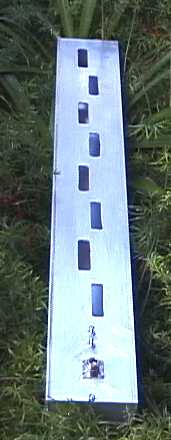
PLASMON SLOT WAVEGUIDE DISPERSION The eigenmodes of planar multilayer structures may be solved via the vector wave equation under constraint of tan- gentialEand normalDfield continuity. Uniqueness of the results is guaranteed by the Helmholtz theorem. Omnidirectional Sector Waveguide SLOT Antenna L and C Band (1296 & 2320 MHz) The slotted waveguide has achieved most of its success when used in an omnidirectional role. It is the simplest way to get a real 10dB gain over 360 degrees of beamwidth. A circularly polarized waveguide slot array includes first and second waveguide sections, the first waveguide section extending along a longitudinal axis, and including an antenna element for transmitting or receiving a circularly polarized signal. The second waveguide slot section is coupled side-to-side with the first waveguide slot section and extends along the longitudinal axis, the second. A slot-waveguide is an optical waveguide that guides strongly confined light in a subwavelength-scale low refractive index region by total internal reflection. A slot-waveguide consists of two strips or slabs of high-refractive-index (n H) materials separated by a subwavelength-scale low-refractive-index (n S) slot region and surrounded by low-refractive-index (n C) cladding materials.
Simulation of silicon cross-slot waveguide with FIMMWAVE software
FIMMWAVE's mode solvers were used to calculate the modes of a silicon cross-slot waveguide; slot waveguides use a combination of high-index and low-index layers to generate light confinement.
FIMMWAVE can be used to model any slot waveguide geometry built from any materials, including silicon, polymer and hybrid slot waveguides. The silicon cross-slot waveguide presented here is taken from an article from Helsinki University of Technology [1], featuring FIMMWAVE simulations. The paper also presents results for waveguide geometries with angled sidewalls.
See also [2], also featuring FIMMWAVE simulations for the modelling of slot waveguides.
Silicon slot waveguide designed in FIMMWAVE
The modes of the silicon slot waveguide were calculated using FIMMWAVE's fully vectorial FDM Solver. The calculation only took a few seconds, and the solver was able to take advantage of the waveguide symmetry.
This waveguide is a single-mode waveguide, and the fundamental TE-like mode and TM-like mode are shown below. You can see clearly how the cross-slot geometry generates a 90-degree rotation of the field distribution between the two polarisations. FIMMWAVE can also provide a large number of mode properties, including effective index, propagation constant, group index, dispersion, polarisation, effective mode area, confinement factor etc.
Properties of the fundamental TE-like mode of the silicon cross-slot waveguide:
(clockwise from top-left) intensity profile, Ex field profile and horizontal section, mode properties
Properties of the fundamental TM-like mode of the silicon cross-slot waveguide:
(clockwise from top-left) intensity profile, Ey field profile and horizontal section, mode properties
FIMMWAVE allows you to check the accuracy of your calculation as it features three independent fully-vectorial Cartesian mode solvers: the FMM, FDM and FEM Solvers. We ran the simulation with all three solvers and found the results to be in excellent agreement.
FIMMPROP, the propagation tool associated with FIMMWAVE, can also be used to model light propagating within slot-waveguide structures.
References
[1] A. Khanna, A. Säynätjoki, A. Tervonen and S. Honkanen, 'Control of optical mode properties in cross-slot waveguides', Applied Optics 48, 34, pp. 6547-6552 (2009)
[2] M.P. Hiscocks, C. Su, B. Gibson, A.D. Greentree, L.C.L. Hollenberg, and F. Ladouceur, 'Slot-waveguide cavities for optical quantum information applications', Optics Express 17, 9, p7295-7303 (2009)
More publications
Click here to find publications that include FIMMWAVE simulations of slot waveguides on Google Scholar.
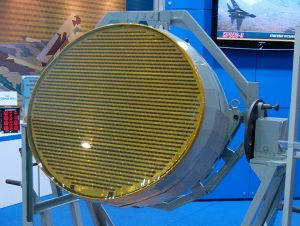
A slot antenna consists of a metal surface, usually a flat plate, with one or more holes or slots cut out. When the plate is driven as an antenna by an applied radio frequency current, the slot radiates electromagnetic waves in a way similar to a dipole antenna. The shape and size of the slot, as well as the driving frequency, determine the radiation pattern. Slot antennas are usually used at UHF and microwave frequencies at which wavelengths are small enough that the plate and slot are conveniently small. At these frequencies, the radio waves are often conducted by a waveguide, and the antenna consists of slots in the waveguide; this is called a slotted waveguide antenna. Multiple slots act as a directivearray antenna and can emit a narrow fan-shaped beam of microwaves. They are used in standard laboratory microwave sources used for research, UHF television transmitting antennas, antennas on missiles and aircraft, sector antennas for cellular base stations, and particularly marine radar antennas. A slot antenna's main advantages are its size, design simplicity, and convenient adaptation to mass production using either waveguide or PC board technology.
Structure[edit]
Slotted Waveguide Antenna Squint
As shown by H. G. Booker in 1946, from Babinet's principle in optics a slot in a metal plate or waveguide has the same radiation pattern as a driven rod antenna whose rod is the same shape as the slot, with the exception that the electric field and magnetic field directions are interchanged; the antenna is a magnetic dipole instead of an electric dipole; the magnetic field is parallel to the long axis of the slot and the electric field is perpendicular. Thus the radiation pattern of a slot can be calculated by the same well-known equations used for rod element antennas like the dipole. The waves are linearly polarized perpendicular to the slot axis. Slots up to a wavelength long have a single main lobe with maximum radiation perpendicular to the surface.
Antennas consisting of multiple parallel slots in a waveguide are widely used array antennas. They have a radiation pattern similar to a corresponding linear array of dipole antennas, with the exception that the slot can only radiate into the space on one side of the waveguide surface, 180° of the surrounding space. There are two widely used types:

- Longitudinal slotted waveguide antenna - The slots' axis is parallel to the axis of the waveguide. This has a radiation pattern similar to a collinear dipole antenna, and is usually mounted vertically. The radiation pattern is almost omnidirectional in the horizontal plane perpendicular to the antenna over the 180° azimuth in front of the slot, but narrow in the vertical plane, with the vertical gain increasing approximately 3 dB with each doubling of the number of slots. The radiation is horizontally polarized. It is used for vertical omnidirectional transmitting antennas for UHF television stations. For broadcasting, a cylindrical or semicircular waveguide is sometimes used with several columns of slots cut in different sides to give an omnidirectional 360° radiation pattern.
- Transverse slotted waveguide antenna - The slots are almost perpendicular to the axis of the waveguide but skewed at a small angle, with alternate slots skewed at opposite angles. This radiates a dipole pattern in the plane perpendicular to the antenna, and a very sharp beam in the plane of the antenna. Its largest use is for microwave marine radar antennas. The antenna is mounted horizontally on a mechanical drive that rotates the antenna about a vertical axis, scanning the antenna's vertical fan-shaped beam 360° around the water surface surrounding the ship out to the horizon with each revolution. The wide vertical spread of the beam ensures that even in bad weather when the ship and the antenna axis is being rocked over a wide angle by waves the radar beam will not miss the surface.
History[edit]
The slot antenna was invented in 1938 by Alan Blumlein, while working for EMI. He invented it in order to produce a practical type of antenna for VHF television broadcasting that would have horizontal polarization, an omnidirectional horizontal radiation pattern and a narrow vertical radiation pattern.[1][2]
Prior to its use in surface search radar, such systems used a parabolic segment reflector, or 'cheese antenna'. The slotted waveguide antenna was the result of collaborative radar research carried on by McGill University and the National Research Council of Canada during World War II.[3] The co-inventors, W.H. Watson and E.W. Guptill of McGill, were granted a United States patent for the device, described as a 'directive antenna for microwaves', in 1951.[4]
Other uses[edit]
In a related application, so-called leaky waveguides are also used in the determination of railcar positions in certain rapid transit applications. They are used primarily to determine the precise position of the train when it is being brought to a halt at a station, so that the doorway positions will align correctly with queuing points on the platform or with a second set of safety doors should such be provided.
See also[edit]
- Microwave Radiometer (Juno) (has a slot array antenna)
- RIMFAX (radar for Mars rover has slot antenna design)
References[edit]
- ^Blumlein, Alan (1938-03-07), 'Improvements in or relating to high frequency electrical conductors or radiators', British patent no. 515684
- ^Burns, Russell (2000). The life and times of A.D. Blumlein. Institution of Engineering and Technology. ISBN0-85296-773-X.
- ^Covington, Arthur E. (1991). 'Some recollections of the radio and electrical engineering division of the National Research Council of Canada, 1946-1977'. Scientia Canadensis: Canadian Journal of the HIstory of Science, Technology and Medicine. 15 (2): 155–175. doi:10.7202/800334ar.
- ^Watson, William Heriot; Guptill, Ernest Wilmot (6 November 1951), Directive Antenna for Microwaves, retrieved 20 December 2016
Slot Waveguide Antenna
External links[edit]
- 'Slot Antennas'. Antenna Theory.
- Slotted Waveguide Antennas Antenna-Theory.com